
Fragmented Material Data
Material data is scattered across PDFs, manufacturer websites, and distributor catalogs. Finding a complete picture for any single resin means checking three or four different sources before you can make a comparison.






Material data is scattered across PDFs, manufacturer websites, and distributor catalogs. Finding a complete picture for any single resin means checking three or four different sources before you can make a comparison.
Getting basic specs and datasheets requires days of back-and-forth emails with suppliers. By the time you have the information you need, the design review has already passed.
Specifying the wrong plastic material late in the design cycle means going back to the drawing board. Tooling changes, timeline delays, and wasted engineering hours add up fast.
Describe your application requirements and Herman recommends the right plastic resin or engineering plastic from 45,000+ materials. Trained on 350,000+ pages of curated industry data, Herman is 67% more accurate than general-purpose AI.
Side-by-side property comparison across mechanical, thermal, and chemical properties. Filter by material family, application, or manufacturer to narrow your selection in minutes, not days.
Request quotes from verified plastic resin distributors and manufacturers. Get pricing in 24 hours, not weeks. Connect directly with suppliers for samples and production volumes.
See how design engineers use Plastics.com to go from a set of application requirements to a sourced material — without leaving the platform.
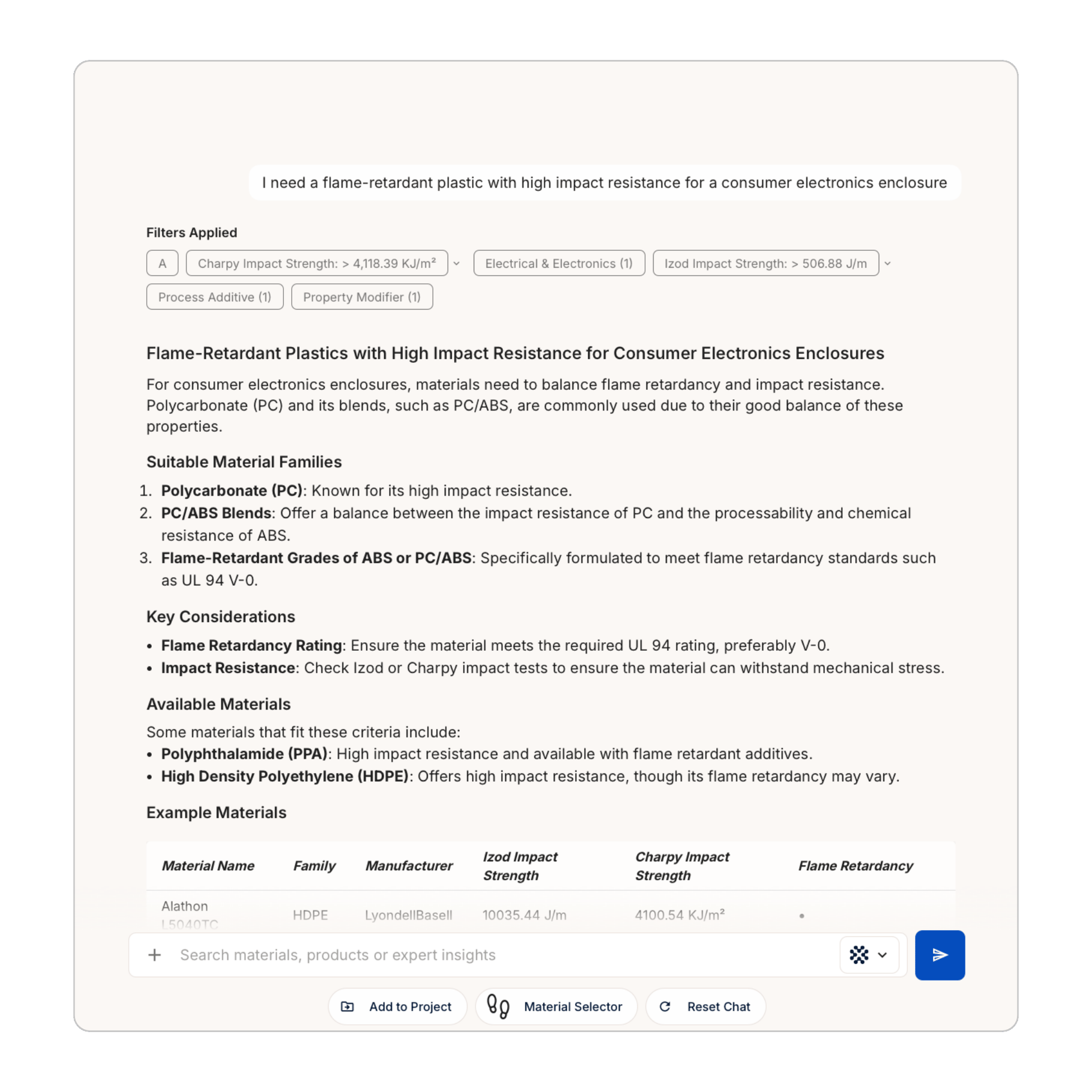
You're designing a consumer electronics housing that needs impact resistance, flame retardancy, and a Class A surface finish. Instead of spending days searching datasheets, ask Herman:
"I need a flame-retardant plastic with high impact resistance for a consumer electronics enclosure."
Herman instantly recommends materials like PC/ABS blends and flame-retardant nylon, compares their properties, and connects you with suppliers who can quote today.
Excellent wear resistance, mechanical strength, and thermal stability. Nylon is the standard choice for gears, bearings, structural components, and under-the-hood automotive parts.
Strong chemical resistance, dimensional stability, and excellent electrical properties. Polyester resins are specified for connectors, electrical housings, automotive components, and food-contact packaging.
Plastics.com gives design engineers access to more than 45,000 plastic materials across 37+ material families. The marketplace covers everything from commodity resins like ABS, polypropylene, and polyethylene to high-performance engineering plastics including PEEK, PEI, and liquid crystal polymers. Materials are sourced from 50+ leading manufacturers such as BASF, SABIC, DuPont, Celanese, and Covestro, and are available through 100+ verified distributors and suppliers.
Herman AI is the built-in assistant on Plastics.com trained on more than 350,000 pages of curated plastics industry data. Design engineers describe their application requirements — such as operating temperature, chemical exposure, mechanical loads, and surface finish — and Herman recommends matching plastic resins from the marketplace. Herman is 67% more accurate than general-purpose AI tools and achieves a 98% reduction in hallucinations, making it a reliable starting point for material selection in product design.
Yes. Plastics.com is 100% free for buyers, including design engineers, product designers, and procurement teams. There is no credit card required to sign up. Engineers can search the full material database, compare properties side by side, consult Herman AI, and request quotes from suppliers at no cost.
After identifying candidate materials on Plastics.com, design engineers can request quotes from verified suppliers and typically receive pricing within 24 hours. Engineers connect directly with distributors and manufacturers through the platform to arrange samples, small-quantity orders, or production-volume pricing, significantly reducing the lead time compared to traditional sourcing methods.